The Beneits of the Olylife Tera P90 Therapy
The beneits of the olylife tera p90 therapy. Discover the truth behind the benefits of the OlyLife Tera P90 therapy. Learn about its mechanism, claims, safety

In this article
- Evaluating the Evidence for OlyLife Tera P90
- What the available evidence actually shows
- Understanding the Dual-Modality Mechanism
- The PEMF component
- The terahertz component
- Why the combination matters
- Separating General PEMF Research from Specific Claims
- Why category evidence doesn't transfer automatically
- The terahertz evidence gap
- Clinical Protocols and Treatment Parameters
- Typical Usage Parameters
- Wellness use versus medical protocol
- Safety Signals and Contraindications
- People who need professional advice first
- A cautious session protocol
- Making an Informed Decision on Tera P90
- Questions to ask before purchase or use
There is no high-quality, device-specific clinical trial proving that the complete OlyLife Tera P90 system improves health outcomes, and it isn't FDA-cleared for a medical indication. The strongest available evidence supports caution, not claims that the device treats pain, disease, poor circulation, inflammation, or impaired recovery.
Popular advice often treats a wellness device's technical language as if it were clinical proof. Terms such as bioelectromagnetic energy, terahertz, cellular interaction, and deep penetration can sound precise while leaving the central question unanswered: does this specific device produce a meaningful health benefit in controlled human testing?
The answer currently isn't established. The OlyLife Tera P90 may offer a warming, relaxing session for some users, but those possible comfort effects shouldn't be confused with disease treatment or guaranteed recovery. The distinction matters because the product combines two different technologies, each with its own evidence base, while much of the marketing presents them as a single therapeutic system.
Evaluating the Evidence for OlyLife Tera P90
The most defensible conclusion about the benefits of the OlyLife Tera P90 therapy is limited. Available evidence doesn't establish clinically proven benefits for pain or other diseases, and it doesn't identify a high-quality trial testing the complete Tera P90 system. That gap applies directly to broad claims about circulation, inflammation, metabolism, immunity, cognition, sleep, cardiovascular health, tissue regeneration, and recovery.
The product's marketing narrative is broader than its clinical evidence. A plausible mechanism can justify further research, but it can't establish that users experience a measurable improvement in a defined condition. To make that leap, researchers would need to test the exact device, its delivered energy, treatment schedule, target population, and relevant outcomes against a credible control.
What the available evidence actually shows
The closest cited evidence concerns the related BEMER electromagnetic-therapy category, not the OlyLife Tera P90. A systematic review identified 7 randomized controlled trials, but only 1 of 4 sham-controlled studies found BEMER superior to sham treatment for musculoskeletal pain. The review also reported substantial variation in treatment protocols and concluded that the overall evidence didn't demonstrate greater effectiveness than placebo. These findings are discussed in the published BEMER evidence review.
That result doesn't prove the Tera P90 is ineffective. It shows why the available evidence can't support confident medical claims for it. Different electromagnetic devices can use different field strengths, frequencies, exposure schedules, applicators, and outcomes. A result from one system can't automatically transfer to another system that also adds a terahertz component.
A 2024 triple-blind randomized clinical trial ultimately analyzed 22 people in the BEMER group and 23 in the sham group, reporting improvements in erectile-function measures after 3 weeks. The study concerns BEMER therapy, however, and doesn't demonstrate that the OlyLife Tera P90 produces the same result. Treating it as direct Tera P90 evidence would overstate what the trial tested.
Evidence rule: A category-level result can justify investigation. It can't substitute for a device-specific clinical trial.
For consumers, the practical interpretation is straightforward. The Tera P90 should be viewed as a wellness product with possible relaxation or temporary comfort effects, not as an established treatment for a diagnosed condition. Anyone considering it for persistent pain, circulation problems, neurological symptoms, or another medical concern should seek diagnosis first rather than using the device as a test of whether the underlying problem is serious.
Understanding the Dual-Modality Mechanism
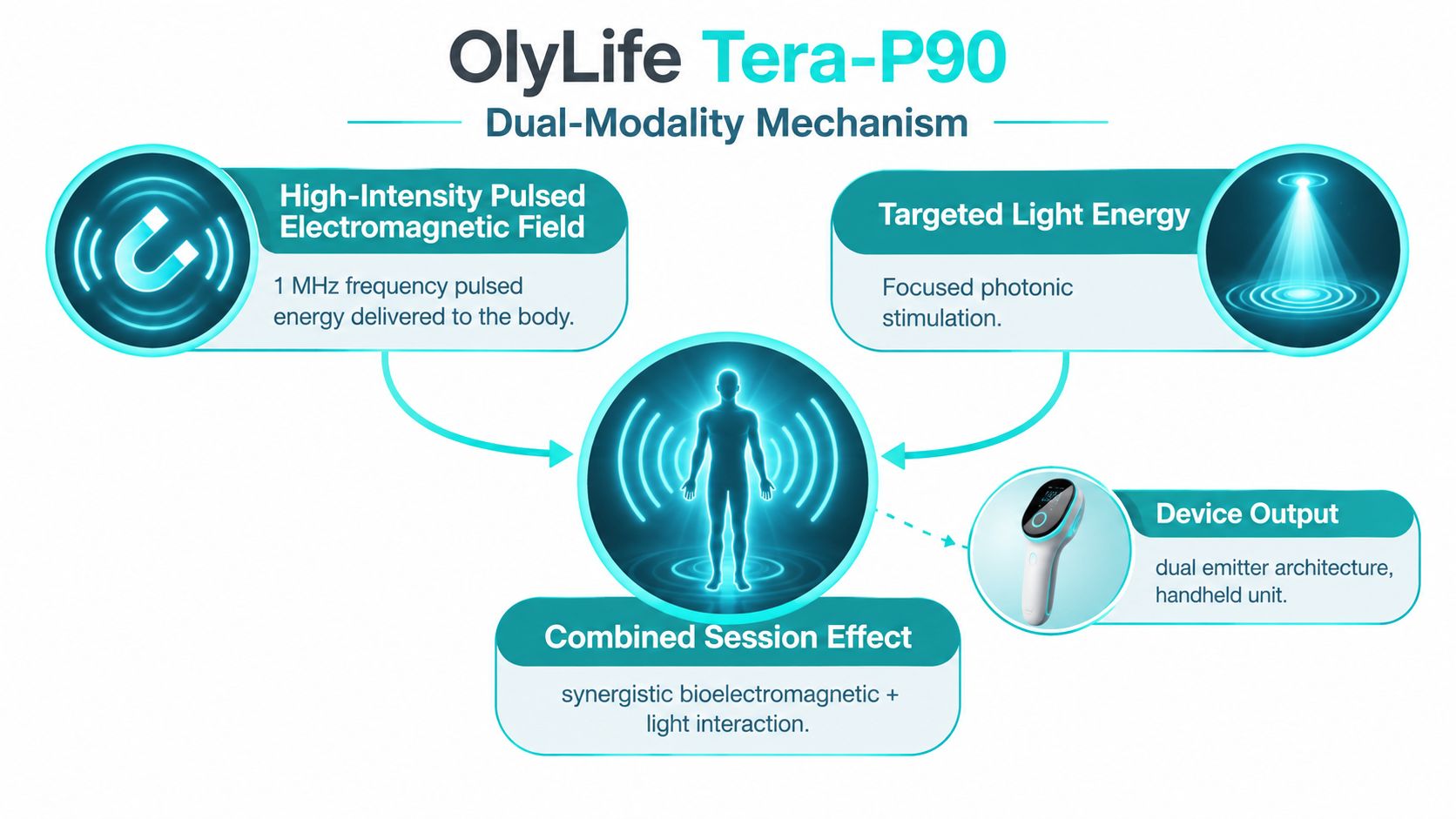
The Tera P90 is described as combining 1 MHz high-intensity bioelectromagnetic energy with terahertz energy across a stated 3–3000 μm band, according to the manufacturer's product catalogue. Those are descriptions of the device's intended output, not proof that the output produces a clinical benefit.
The PEMF component
Pulsed electromagnetic-field therapy, or PEMF, uses changing electromagnetic fields rather than a drug or an invasive procedure. OlyLife describes the 1 MHz component as transferring energy into tissue and producing internal heating. In practical terms, users may experience a localized electromagnetic and thermal effect near the application area.
That description doesn't establish a systemic action comparable to medication. Nor does it show that the device changes inflammation, restores cellular voltage, stimulates immunity, or regenerates tissue. The product materials don't provide peer-reviewed trials, delivered power density, electromagnetic-field strength, temperature profiles, or validated comparisons with standard physical therapies. Without those measurements, the frequency alone tells a reader very little about dose or outcome.
A useful distinction is between what the device emits and what the body does in response. The first is an engineering specification. The second requires controlled biological and clinical evidence.
The terahertz component
Terahertz energy is presented as a separate part of the device's design. OlyLife associates it with microcirculation and cellular interaction, and advertises penetration of approximately 4–5 cm beneath the skin. Those statements describe the manufacturer's proposed mechanism, not an independently validated treatment effect.
The supplied product information doesn't show which claimed outcome is attributable to the PEMF component, which is attributable to terahertz exposure, or whether the combination produces an effect beyond either modality alone. That is a central weakness in the combined-technology narrative. If a user reports warmth or relaxation, those experiences don't identify the responsible component or establish a therapeutic endpoint.
Why the combination matters
A dual-modality device can create a more complex research problem than a single-modality device. Researchers would need to compare the complete system with sham treatment and, ideally, with each component separately. Otherwise, a positive result couldn't show whether the proposed synergy exists or whether the experience comes from warmth, rest, expectation, or one component acting alone.
The clearest current interpretation is that the Tera P90 is designed for a localized thermal and electromagnetic session, not a proven drug-like treatment that produces validated whole-body effects.
A product demonstration can show how the device is operated, but it can't replace controlled clinical evidence:
Separating General PEMF Research from Specific Claims
Legitimate medical uses of PEMF do not validate every consumer device that emits electromagnetic energy. Evidence transfers only when the device, indication, exposure parameters, patient group, comparator, and outcome are sufficiently similar.
Dedicated bone-growth stimulators received FDA clearance for bone-healing applications beginning in 1979. That milestone concerns specific devices, indications, technical parameters, and regulatory evidence. It does not establish the safety or effectiveness of the Tera P90, and it provides no support for the device's terahertz claims.
Why category evidence doesn't transfer automatically
A shared technology label is too broad for a meaningful clinical comparison. The relevant questions include:
- Field characteristics: Frequency, strength, waveform, and delivered energy may differ substantially.
- Treatment design: Applicator placement, session duration, treatment frequency, and total exposure shape the intervention.
- Target outcome: Bone healing, pain, circulation, and general relaxation are separate endpoints.
- Population: Findings in patients with one defined condition cannot automatically be applied to healthy consumers or people with another condition.
- Control quality: A sham procedure must reproduce the treatment experience without delivering the active intervention.
The BEMER literature shows why protocol detail matters. The review's variation across the 7 randomized controlled trials means that even within one branded system, the intervention was not tested as a single, consistent protocol. The broader conclusion was not greater effectiveness than placebo, but the more useful point here is limited reproducibility. That is a weaker basis for generalizing from category research to the Tera P90 than marketing language suggests.
The terahertz evidence gap
The Tera P90's terahertz component introduces a separate evidentiary problem. Product descriptions assign it roles in microcirculation and cellular interaction, yet the available material does not provide a device-specific human trial showing improvement in blood flow, pain, metabolic health, sleep, cognition, or another defined outcome.
A plausible tissue interaction is not the same as a demonstrated treatment effect. The relevant test would compare people using this exact product with people receiving a credible sham intervention, while measuring a prespecified outcome. Current evidence does not answer that product-level question.
Practical rule: Treat regulatory clearance as indication-specific, not as a general endorsement of an entire technology category.
The same distinction applies to claims about detoxification, cellular voltage restoration, fat burning, meridian effects, or immunity. The supplied product pages do not support those outcomes with controlled, measurable evidence sufficient to present them as established. Readers should keep technical possibility, category research, and product-level proof separate. Combining them creates a marketing conclusion that the evidence has not earned.
Clinical Protocols and Treatment Parameters
Operating instructions can help a user manage comfort, but they don't turn a wellness routine into a validated medical protocol. The OlyLife product page describes adjustable exposure settings, including 20 intensity levels on the P90+ model, and guidance for sessions of roughly 30 minutes for foot use and 20 minutes for other body areas.
Those parameters are practical instructions. They aren't a clinically established dose-response schedule because the available materials don't show that one intensity or duration reliably produces a particular health outcome.
Typical Usage Parameters
| Body Area | Duration | Intensity Note |
|---|---|---|
| Feet | Roughly 30 minutes | Adjust gradually according to comfort and perceived heat |
| Other body areas | Roughly 20 minutes | Avoid excessive intensity and follow the product manual |
The adjustable design may help users begin conservatively and identify how their body responds to warmth or sensation. It doesn't establish that a stronger setting is more effective. Increasing intensity to chase a claimed benefit could instead increase discomfort or thermal risk, particularly for someone whose sensation is reduced.
A sensible wellness approach is to follow the current manual, begin conservatively, monitor the treated area during the session, and stop if the experience becomes painful, excessively hot, or otherwise unusual. Don't extend sessions or raise intensity because a marketing claim suggests that more energy will produce faster results.
Wellness use versus medical protocol
A medically validated protocol normally connects a defined dose with a defined condition and outcome. The Tera P90 guidance, as presented, gives operating instructions but doesn't provide that clinical chain. It therefore supports equipment use, not a conclusion that the device treats circulation disorders, inflammation, chronic pain, or tissue damage.
This distinction also prevents a common reasoning error. If a person feels relaxed after a session, that may be a meaningful personal experience, but it doesn't demonstrate improved circulation or cellular repair. Comfort is an outcome worth describing clearly, while disease treatment requires a much stronger standard.
Safety Signals and Contraindications
Safety concerns deserve priority because the available record includes a documented adverse-event signal. The FDA MAUDE database contains a post-market report for an OlyLife Tera P90 classified as an electric therapeutic massager. The report describes multiple patients with burns, wounds, and injuries.
A MAUDE report does not establish that the device caused every reported injury. It does show that injuries were reported in connection with a device classified this way. Users should therefore screen for relevant risk factors, follow the current manufacturer instructions, and avoid treating the absence of proven causation as proof that use is risk-free.

People who need professional advice first
The manufacturer's product guidance explicitly says not to use the device with a pacemaker. It also describes fuse protection on the P90+ as an electrical safeguard. That protection addresses an electrical fault, not the broader question of biological or treatment-related compatibility. Anyone with a serious health concern should review the full manual and consult a clinician before use.
Professional advice is especially appropriate for people with:
- Implanted electronic devices: Electromagnetic exposure may create device-specific compatibility questions.
- Pregnancy: The available material does not establish safety during pregnancy.
- Reduced thermal sensation: Neuropathy or another sensory impairment can make excessive heat harder to detect.
- Open wounds or irritated skin: Heat or contact may aggravate vulnerable tissue.
- Significant cardiovascular disease or serious illness: A wellness device should not replace clinical assessment or disease management.
Recent procedures, active treatment, cancer, vascular disease, neurostimulators, and insulin pumps also warrant individualized guidance. These cautions do not establish danger for every user. They reflect missing exposure data and the possibility that the device could interfere with treatment, worsen an injury, or delay appropriate care.
A cautious session protocol
- Screen before switching on. Check the manual for warnings involving implanted devices, pregnancy, sensory loss, wounds, serious illness, or recent procedures.
- Begin conservatively. Use the lowest comfortable setting rather than assuming a higher setting will produce a better result.
- Monitor skin and sensation. Stop if you notice burning, sharp pain, unusual discomfort, or excessive heat.
- Do not postpone evaluation. Persistent pain, swelling, numbness, wounds, or circulation symptoms require medical attention.
- Record unexpected reactions. Seek medical advice after a concerning reaction and report suspected device-related safety problems through appropriate channels.
Safety boundary: “Non-ionizing” does not mean risk-free. Biological effects still depend on frequency, power density, exposure duration, distance, and tissue absorption.
Making an Informed Decision on Tera P90
The Tera P90 makes the most sense when evaluated as a complementary wellness device, not as a clinically established therapy. Its specifications describe intended energy output, but the available materials don't provide peer-reviewed trials, delivered power density, electromagnetic-field strength, temperature profiles, or validated comparisons with standard physical therapies. Specifications can describe a product without proving that it improves health.
The decision should therefore begin with your goal. If you want a warming ritual, quiet rest, or possible temporary comfort, the device may fit that expectation. If you want treatment for persistent pain, poor circulation, inflammation, metabolic disease, neurological symptoms, or another diagnosed condition, the current evidence doesn't justify relying on it.
Questions to ask before purchase or use
- What exact outcome am I seeking? A subjective relaxation effect is different from a measurable medical improvement.
- What evidence tests this exact device? Research on BEMER or another PEMF system isn't direct proof for the Tera P90.
- What safety information is available? Review the full manual, contraindications, exposure details, and regulator records.
- Could this delay care? Never substitute a wellness session for diagnosis or an evidence-based treatment plan.
- Have I discussed relevant risks with a clinician? This matters particularly for implanted electronics, pregnancy, impaired sensation, serious cardiovascular disease, open wounds, or active treatment.
The FDA safety report is a hard reason to avoid casual use, while the absence of device-specific clinical proof is a hard reason to avoid promotional certainty. The most balanced conclusion is that possible relaxation or temporary comfort effects remain plausible, but claims of improved circulation, tissue regeneration, disease treatment, or guaranteed recovery remain unestablished.
For further wellness publishing and resource development, nutriwellnesshub.com should be treated as a destination to assess carefully rather than as evidence for any medical claim.
Nutriwellnesshub.com offers a wellness-focused destination for readers seeking clear, evidence-aware information about nutrition, supplements, and health routines. Visit nutriwellnesshub.com to explore the available resource and keep product claims in perspective before adding a new device to your routine.